Welcome to My Blog!
Before we dive into the content, I’d love for you to join me on my social media platforms where I share more insights, engage with the community, and post updates. Here’s how you can connect with me:
Facebook:https://www.facebook.com/profile.php?id=61565337355573
Now, let’s get started on our journey together. I hope you find the content here insightful, engaging, and valuable.
Table of Contents
Introduction
Structural steel beams form the backbone of countless construction projects, providing essential support and load-bearing capacity. From towering skyscrapers to sturdy bridges and expansive industrial facilities, the selection of the appropriate structural steel beam is a critical decision that directly impacts the safety, stability, and cost-effectiveness of any structure. Understanding the different types of structural steel beams available, along with their unique properties and applications, is paramount for engineers, architects, and construction professionals. This comprehensive guide will delve into the various categories of structural steel beams, highlighting their characteristics, advantages, and typical uses, empowering you to make informed choices for your next project. As a leading provider in the steel construction industry, Guanglei, established in 2002 and holding national Grade I certifications for steel structure professional contracting, manufacturing, and design, alongside its status as a national key steel structure production base, understands the importance of selecting the right structural steel beam for optimal performance.
Understanding the Fundamentals of Structural Steel Beams
Before exploring the specific types of structural steel beams, it’s crucial to grasp the fundamental principles governing their behavior under load. Structural steel beams are primarily designed to resist bending moments, shear forces, and axial loads. The shape and dimensions of a structural steel beam significantly influence its strength and stiffness. Key properties such as the moment of inertia, section modulus, and yield strength of the steel material determine the beam’s ability to withstand these forces without excessive deflection or failure. Different structural steel beam shapes are optimized for specific loading conditions and structural requirements. For instance, some shapes excel at resisting bending, while others are better suited for handling axial compression or tension. Guanglei’s extensive experience in steel structure design and manufacturing allows us to provide insights into the optimal structural steel beam selection based on a thorough analysis of these fundamental principles.
The Versatile I-Beam: A Common Structural Steel Beam Choice

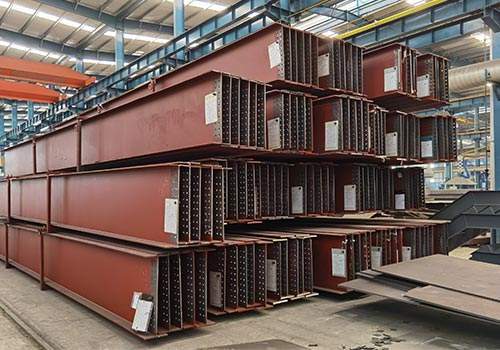
The I-beam, also known as the H-beam or wide flange beam, stands as one of the most commonly used structural steel beam types in construction. Its distinctive “I” or “H” cross-section comprises two horizontal flanges connected by a vertical web. This shape provides excellent resistance to bending due to the concentration of steel in the flanges, which are located furthest from the neutral axis. The web provides shear strength and prevents buckling of the flanges. I-beams are incredibly versatile and are employed in a wide array of applications, including floor joists, roof supports, columns, and bridge girders. Their efficiency in resisting both bending and shear makes them a preferred structural steel beam for many general construction purposes. Guanglei utilizes high-quality steel in the fabrication of our I-beams, ensuring superior strength and durability for diverse structural applications.
Channel Beams: Providing Edge and Lateral Support with Structural Steel
Channel beams, characterized by their “C” shaped cross-section, offer unique advantages in structural steel applications where edge support or resistance to lateral bending is required. The single web and two parallel flanges create a profile that is less resistant to bending in one plane compared to an I-beam but provides excellent stiffness in the other. Channel beams are often used as lintels above door and window openings, as stair stringers, and as supplementary members to provide lateral bracing to other structural steel elements. Their shape allows for easy connection to walls or other surfaces, making them a practical structural steel beam choice for specific detailing requirements. Guanglei’s manufacturing capabilities include the production of precise and reliable channel beams to meet various structural design needs.
Angle Beams: Essential Components in Structural Steel Connections
Angle beams, with their “L” shaped cross-section formed by two legs meeting at a 90-degree angle, are fundamental components in structural steel connections and framing. They are primarily used as connecting elements, such as cleats, brackets, and stiffeners, to join other structural steel members like beams and columns. Angle beams can also be used as light structural members in truss systems or for edge protection. Their simplicity and ease of fabrication make them a cost-effective and widely used structural steel component. Guanglei supplies a variety of angle beam sizes and thicknesses, ensuring compatibility with diverse structural steel assembly requirements.
Hollow Structural Sections (HSS): Strength and Aesthetics in Structural Steel Design
Hollow Structural Sections (HSS), also known as steel tubes, are structural steel members with a hollow cross-section, available in square, rectangular, and circular shapes. HSS offers excellent strength-to-weight ratios and uniform resistance to buckling in all directions, making them ideal for columns, trusses, and aesthetically exposed structural elements. The enclosed shape also provides better resistance to torsional loads compared to open sections. Square and rectangular HSS are often used in building frames and welded assemblies, while circular HSS is frequently chosen for its aesthetic appeal in exposed structures and for its superior resistance to torsional buckling. Guanglei provides a range of high-quality HSS products, contributing to both the structural integrity and visual appeal of modern constructions.
Tee Beams: Specialized Structural Steel for Specific Load Transfer
Tee beams, characterized by their “T” shaped cross-section, are specialized structural steel members primarily used in composite construction, where a concrete slab is connected to the top flange of the tee beam to act as a unified structural element. They can also be used as lintels or as chord members in trusses. The flange of the tee beam provides a wide surface for connection to other elements or for bearing loads, while the web provides vertical shear capacity. Tee beams are often fabricated by splitting the web of an I-beam. Guanglei’s fabrication expertise allows for the precise production of tee beams tailored to specific project requirements, ensuring efficient load transfer in composite structures.
Plate Girders: Engineered Structural Steel Beams for Heavy Loads
Plate girders are custom-fabricated structural steel beams designed to carry exceptionally heavy loads or span long distances, exceeding the capacity of standard rolled sections. They are constructed by welding steel plates together to form the desired I-shaped or box-shaped cross-section. The dimensions and thickness of the flanges and web can be precisely tailored to meet the specific load and span requirements of a project. Plate girders are commonly used in bridges, large industrial buildings, and other heavy civil engineering structures. Guanglei’s advanced fabrication facilities and experienced engineers are well-equipped to design and manufacture high-capacity plate girders, ensuring structural integrity and safety for even the most demanding projects.
Open-Web Steel Joists: Lightweight and Efficient Structural Steel for Floors and Roofs
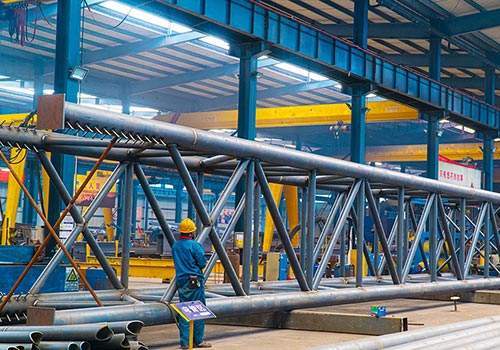
Open-web steel joists are lightweight, prefabricated structural steel trusses used to support floors and roofs. They consist of top and bottom chords connected by diagonal web members, creating an open web pattern. This design provides a high strength-to-weight ratio, allowing for longer spans with less material compared to solid web beams. Open-web steel joists are easy to handle and install, often leading to faster construction times and reduced costs. They also provide convenient pathways for mechanical, electrical, and plumbing systems. Guanglei offers a range of open-web steel joist solutions, providing efficient and cost-effective support systems for various building types.
Structural Steel Beam Selection Criteria: Making the Right Choice
Choosing the right structural steel beam type involves careful consideration of several critical factors. These include the magnitude and type of loads the beam will need to support (dead loads, live loads, wind loads, seismic loads), the span length, the required deflection limits, the connection details, the available space, and the overall cost. Engineers perform structural analysis to determine the forces acting on each beam and then select a structural steel beam with sufficient strength and stiffness to safely carry these loads without excessive deformation. Factors such as fire resistance, corrosion protection, and aesthetic requirements may also influence the selection process. Guanglei’s team of experienced engineers can provide valuable assistance in analyzing these factors and recommending the most appropriate structural steel beam type for your specific project needs.
Structural Steel Beam Properties: A Comparative Overview

To further aid in the selection process, the following table provides a comparative overview of the key properties and typical applications of the different structural steel beam types discussed:
| Structural Steel Beam Type | Cross-Section | Bending Resistance | Shear Resistance | Torsional Resistance | Weight | Typical Applications |
|---|---|---|---|---|---|---|
| I-Beam (Wide Flange) | I | High | Medium | Low | Medium | Floor joists, roof supports, columns, bridge girders |
| Channel Beam | C | Medium | Medium | Low to Medium | Light | Lintels, stair stringers, lateral bracing |
| Angle Beam | L | Low | Low | Low | Light | Connections (cleats, brackets), light structural members |
| Hollow Structural Section (Square/Rectangular) | □ | Medium to High | Medium to High | Medium to High | Medium | Columns, trusses, exposed structural elements |
| Hollow Structural Section (Circular) | ◯ | Medium | Medium | High | Medium | Exposed structures, columns with high torsional loads |
| Tee Beam | T | Medium | Medium | Low | Medium | Composite construction, lintels, truss chords |
| Plate Girder | Custom I or Box | Very High | Very High | Medium to High | Heavy | Bridges, large industrial buildings, heavy civil engineering structures |
| Open-Web Steel Joist | Open Truss | Medium | Low | Low | Very Light | Floor and roof support in commercial and industrial buildings |
Conclusion
Choosing the right structural steel beam is a critical decision that significantly impacts the safety, durability, and cost-effectiveness of any construction project. By understanding the characteristics, advantages, and typical applications of various structural steel beam types – from the versatile I-beam to the efficient open-web steel joist and the heavy-duty plate girder – you can make informed decisions that align with your project’s specific requirements. Guanglei, with its extensive experience and national certifications in steel structure design, manufacturing, and contracting, is committed to providing high-quality structural steel beams and expert guidance to ensure the success of your construction endeavors. Contact us today to discuss your project needs and let our team help you select the ideal structural steel beam solutions.
FAQ
What are the primary types of structural steel beams?
The primary types of structural steel beams include I-beams (wide flange), channel beams, angle beams, hollow structural sections (HSS) in square, rectangular, and circular shapes, tee beams, plate girders, and open-web steel joists. Each type has unique characteristics and is suited for different applications.
How do I determine the right size of structural steel beam for my project?
Determining the correct size of a structural steel beam requires structural analysis performed by a qualified engineer. This analysis considers the loads the beam will support, the span length, and the allowable deflection. Factors such as material strength and connection details are also taken into account.
What are the advantages of using structural steel beams in construction?
Structural steel beams offer several advantages, including high strength-to-weight ratio, durability, ease of fabrication and erection, recyclability, and resistance to pests and decay. They allow for longer spans and can accommodate various architectural designs. Guanglei’s commitment to quality ensures that these advantages are fully realized in our structural steel products.